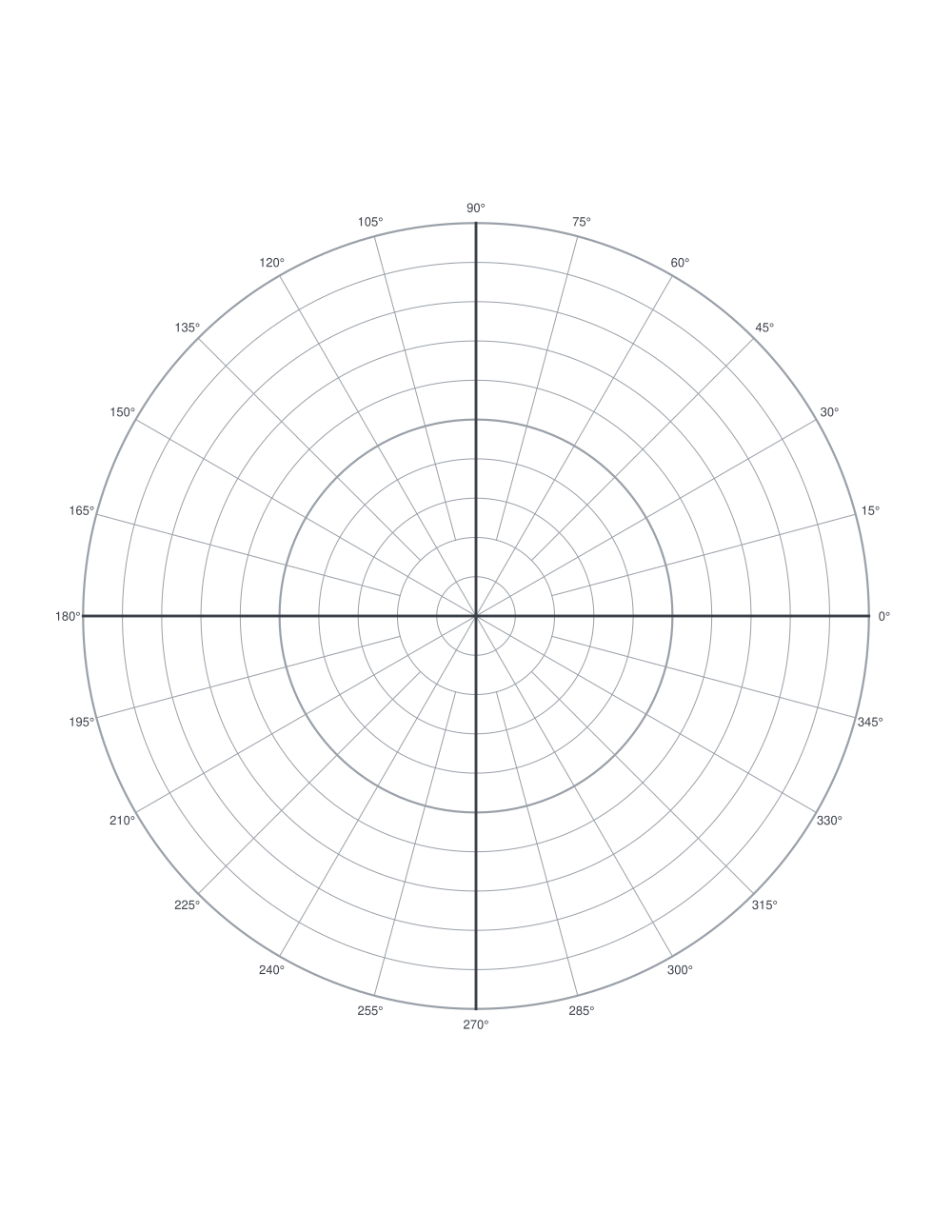
How polar coordinates work
A polar coordinate gives a point's position as a distance and an angle, (r, θ), instead of x and y. r is how far the point is from the center (the pole), which you count by circles. θ is the angle measured counter-clockwise from the positive x-axis (0°). The point (4, 60°) is on the fourth circle, along the ray at 60°.
Plotting a polar equation
- Make a table of θ values, for example every 15°, and work out r for each one.
- For each pair, follow the ray at angle θ out to the circle for r.
- If r is negative, go the same distance in the opposite direction (θ + 180°).
- Join the points with a smooth curve.
Try r = 4 sin θ (a circle), r = 1 + cos θ (a cardioid) or r = 5 cos 3θ (a three-petal rose).
Choosing the angle step
A 15° or 30° step matches the special angles in trigonometry (30°, 45°, 60°, 90°), so it is the most useful for precalculus. 10° and 5° rays suit more detailed curves and engineering work. Rays that do not fall on 30° multiples start a little way out from the center, so the middle of the grid does not fill in with lines.
Polar paper also works as circular graph paper for drawing pie charts, dials, compass roses and mandalas. For x-y graphs, use the coordinate plane.
Frequently asked questions
What is polar graph paper used for?
It is used for plotting polar equations (r = f(θ)) in precalculus and calculus, and for anything circular: pie charts, dials, compass roses, radar plots and mandalas.
Which angle step should I choose?
15° is the best general choice for trigonometry because it includes 30°, 45°, 60° and 90°. Use 5° or 10° for finer curves.
Does polar graph paper use degrees or radians?
The labels are printed in degrees. To work in radians, remember that 30° = π/6, 45° = π/4, 90° = π/2 and 180° = π.