What is the first quadrant?
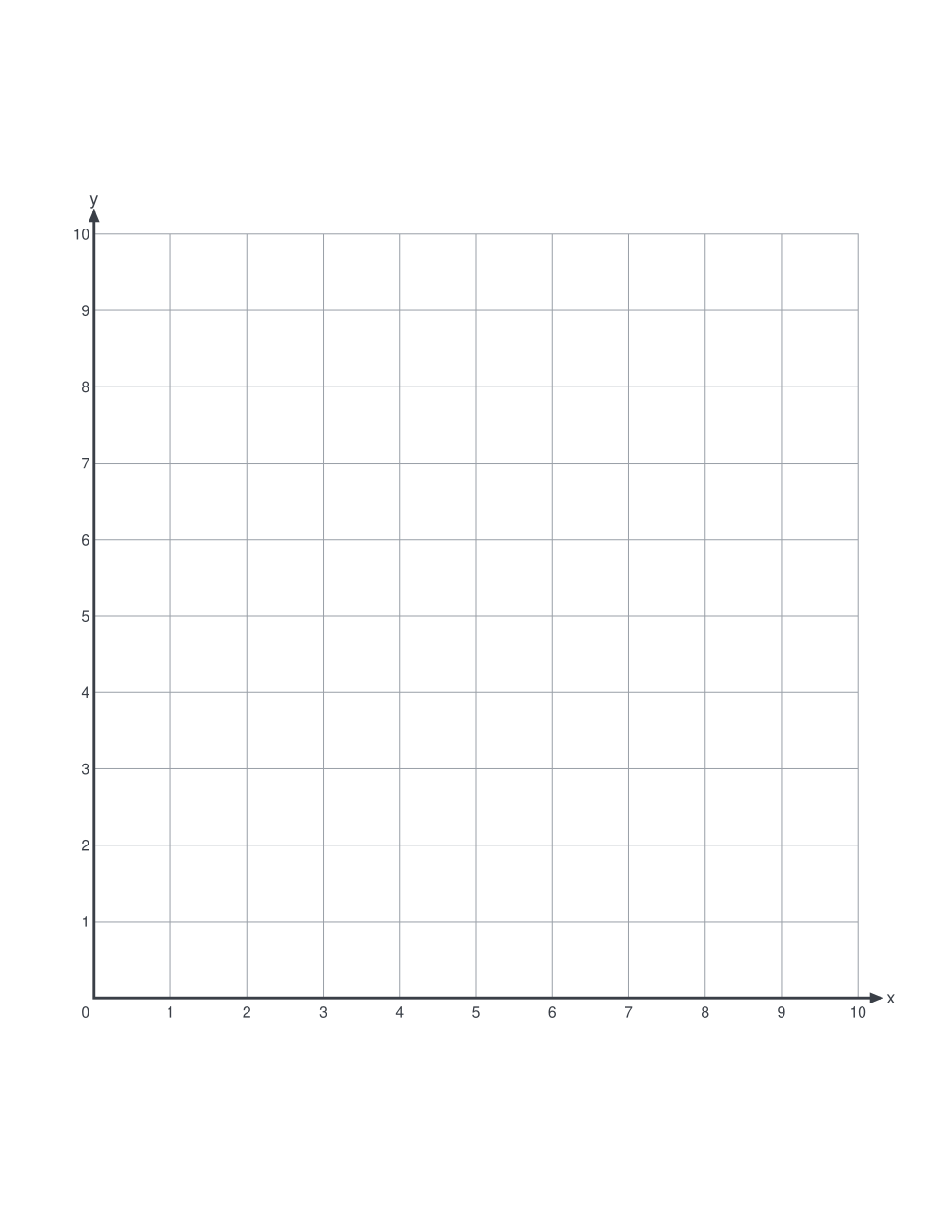
The first quadrant (Quadrant I) is the top-right part of the coordinate plane, where both x and y are positive. First quadrant graph paper shows only this part, so the origin (0, 0) sits in the bottom-left corner and the axes count up from zero. Removing the negative numbers leaves a larger, simpler grid, which is why many classes introduce coordinates this way, usually around grade 5.
What to use it for
- Plotting ordered pairs such as (2, 7) and connecting them to make shapes and pictures.
- Bar graphs and line graphs for data that is never negative, such as heights, temperatures above zero or test scores.
- Science experiments: time on the x-axis, measurement on the y-axis.
- Ratio and proportion tables drawn as straight lines through the origin.
Reading a point on a quadrant 1 grid
Start at the origin. Move right along the x-axis by the first number, then up by the second number. The point (4, 6) is four squares right and six squares up. A handy memory trick is "walk before you climb": always move along x before you move up y.
Frequently asked questions
What is first quadrant graph paper?
It is a coordinate grid that shows only Quadrant I, where x and y are both zero or positive. The origin is in the bottom-left corner.
How many squares should a first quadrant grid have?
0 to 10 is best for beginners. Use 0 to 20 or larger for data that covers a wider range.
Can I label the axes myself?
Yes. Untick "Number the axes" for a blank single-quadrant grid, then write your own scale, for example counting by 5s or 10s.