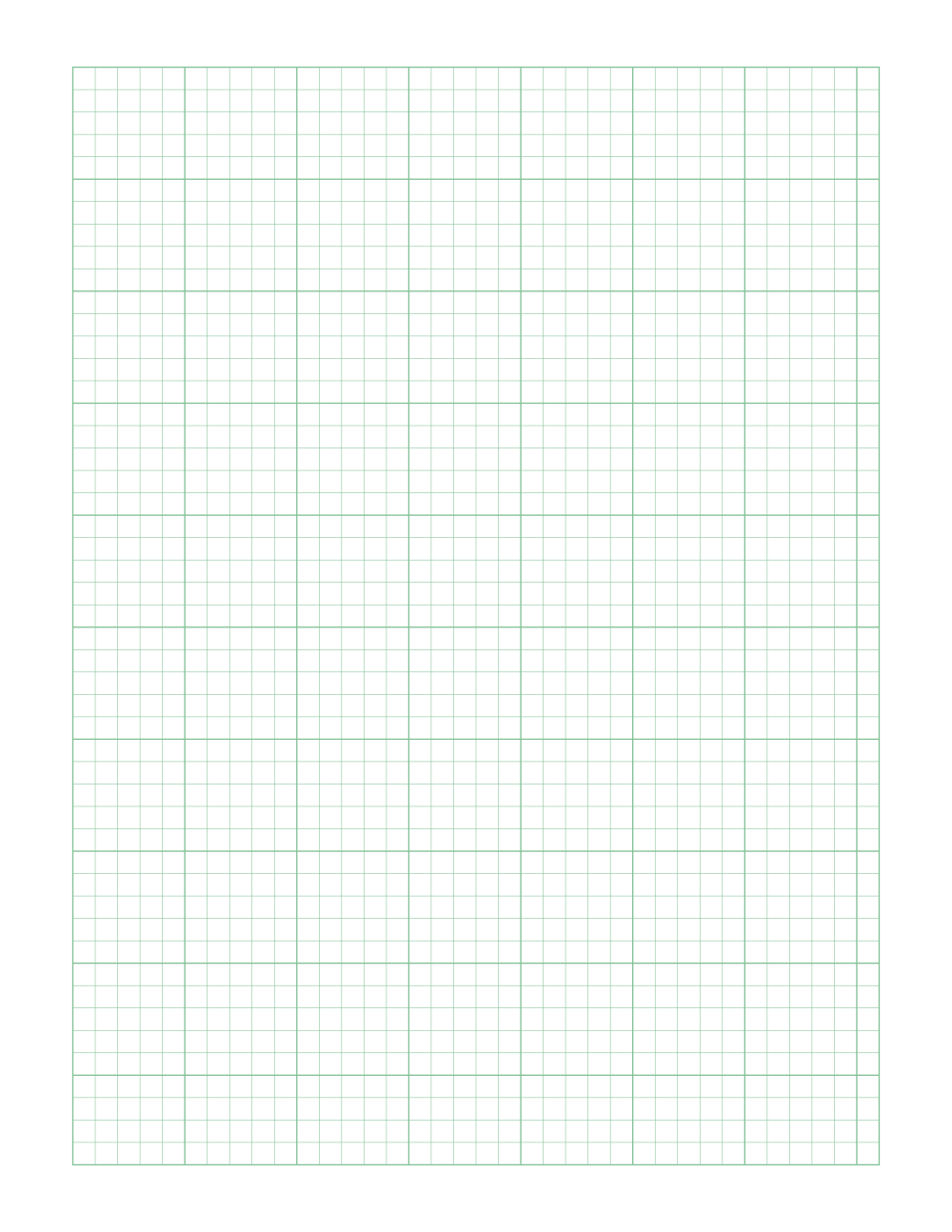
What is engineering paper?
Engineering paper is graph paper made for engineering homework and calculations. The classic version is pale green, with a grid of 5 squares per inch (1/5 inch, 5.08 mm) and a heavier line every inch. Commercial pads print the grid on the back so it shows faintly through, leaving a clean front for writing; a light green grid printed on the front gives a similar effect. A Letter sheet holds 38 × 51 squares.
How to lay out an engineering problem
- Header: write your name, the course, the date and the problem number along the top margin.
- Given: list the known values with units.
- Find: state what you need to calculate.
- Diagram: sketch the system to scale, using the grid.
- Solution: work step by step, one line per step, keeping units on every value.
- Answer: box the final result with its units. Start each new problem on a new sheet.
Engineering paper vs graph paper
Ordinary graph paper usually uses 1/4 inch or 5 mm squares in gray or blue. Engineering paper uses 5 squares per inch, a calm green color that is easy on the eyes, a bold line every inch for quick measuring, and a wider margin for headers and binding. For data plots with decimal scales, many engineers prefer 10 squares per inch; for exponential data, log graph paper.
Frequently asked questions
What is engineering graph paper?
Graph paper with 5 squares per inch, usually in light green with a bold line every inch, used for engineering calculations and sketches.
Why is engineering paper green?
Pale green is easy on the eyes and fades behind pencil and ink, so the working stays readable while the grid still guides alignment.
Can I print engineering paper with a 1 inch border?
Yes. Use the "1 inch border" quick download, or set the margin to 1 inch (25.4 mm).