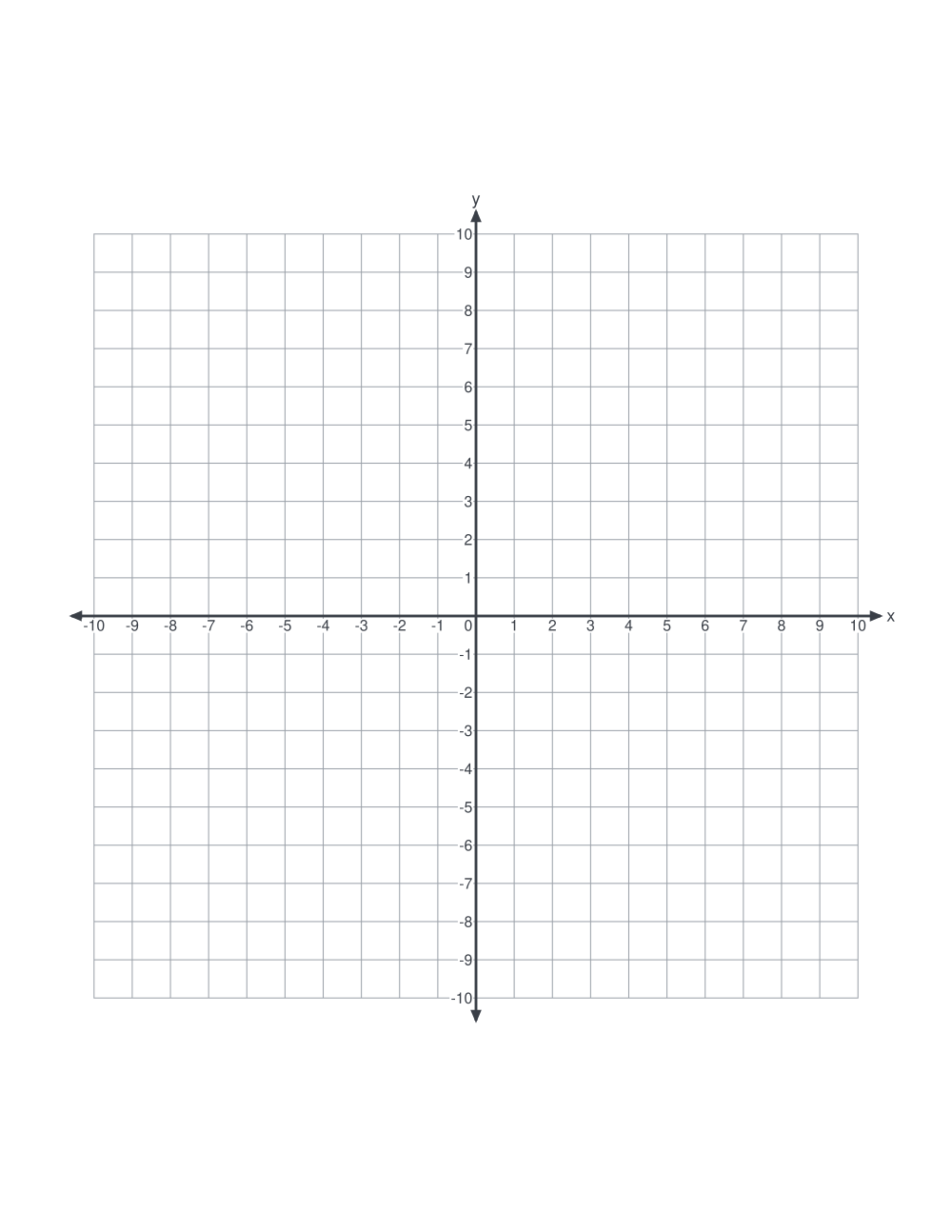
What is a coordinate plane?
A coordinate plane (or Cartesian plane) is a grid with two number lines that cross at right angles: the horizontal x-axis and the vertical y-axis. They meet at the origin, (0, 0). Every point on the plane is named by an ordered pair (x, y). The first number tells you how far to move left or right, and the second how far to move up or down.
Graph paper with numbers: Cartesian coordinate grids
A coordinate plane is also called a Cartesian plane or rectangular coordinate system, after René Descartes. Printable "graph paper with numbers" or "x y axis graph paper" usually means exactly this: a square grid with a numbered x-axis and y-axis crossing at the origin (0, 0). Tick Number the axes for labeled values, or untick it for a blank Cartesian grid students can scale themselves. To plot data that starts at zero, use first quadrant graph paper; to draw on an x-y grid without printing, use online graph paper with axes.
The four quadrants
The axes split the plane into four quadrants, numbered counter-clockwise from the top right:
| Quadrant | Position | Signs of (x, y) | Example |
|---|---|---|---|
| I | Top right | (+, +) | (3, 4) |
| II | Top left | (−, +) | (−3, 4) |
| III | Bottom left | (−, −) | (−3, −4) |
| IV | Bottom right | (+, −) | (3, −4) |
Points that sit on an axis, like (0, 5) or (−2, 0), are not in any quadrant. Working only with positive numbers? Use first quadrant graph paper instead.
Choosing a grid size
- 10 × 10 (−5 to 5): big squares for beginners plotting their first ordered pairs.
- 20 × 20 (−10 to 10): the standard coordinate grid for pre-algebra and algebra homework.
- 30 × 30 or 40 × 40: room for steep lines, wide parabolas and transformations. Numbers switch to every 2 or 5 automatically when the squares get small.
Printing several graphs per page is ideal for worksheets: four 20 × 20 grids per Letter sheet gives each student space to graph four equations. For ready-made layouts aimed at algebra, see math graph paper for linear and quadratic equations.
Frequently asked questions
How do I make a coordinate plane without numbers?
Untick "Number the axes". You get a blank coordinate grid with the x and y axes and arrows, ready for students to add their own scale.
What size is a standard coordinate plane?
For school math, a 20 × 20 grid running from −10 to 10 on both axes is the most common. Younger students often start with 10 × 10 (−5 to 5).
Can I fit more than one coordinate grid on a page?
Yes. Set "Graphs per page" to 2, 4, 6 or 9. The grids and number labels resize to fit the sheet.
Which way are the quadrants numbered?
Counter-clockwise, starting at the top right: Quadrant I (+,+), II (−,+), III (−,−) and IV (+,−).
Is a coordinate plane the same as Cartesian graph paper?
Yes. Coordinate plane, Cartesian plane, rectangular coordinate grid and x y graph paper all mean a grid with a numbered x-axis and y-axis.
Where can I get graph paper with numbers on the axes?
Use this generator with "Number the axes" ticked. The x and y axes are labeled automatically, for example from −10 to 10 on a 20 × 20 grid.